Media & More
Select conference presentations, tutorials, and podcasts below.
Five Pillars Video Walkthrough (Conference Presentation)

The Five Pillars of Enterprise AI Success define the organizational capabilities required to move AI from pilot to production at scale.
This 28-minute video from the Artificially Intelligent Enterprise Conference 2024 covers key aspects of the Five Pillars framework.
-
Platform: Enables AI at scale through governed data, ModelOps, and collaborative environments. Without it, solutions never reach production.
-
Solution Portfolio: Balanced mix of AI initiatives aligned to business value. Combines quick wins, experiments, and long-term bets, all tied to real problems and measurable outcomes.
-
Governance: Provides guardrails for responsible AI. Covers data quality, privacy, explainability, robustness, and integration with enterprise systems.
-
Communication: Translates technical output into business impact. Combines storytelling with metrics to drive understanding, adoption, and trust.
-
Talent: Builds the capability to execute. Focuses on upskilling, cross-training, retention, and maintaining a strong external talent pipeline.
Avoiding AI Deployment Pitfalls (Podcast)
-
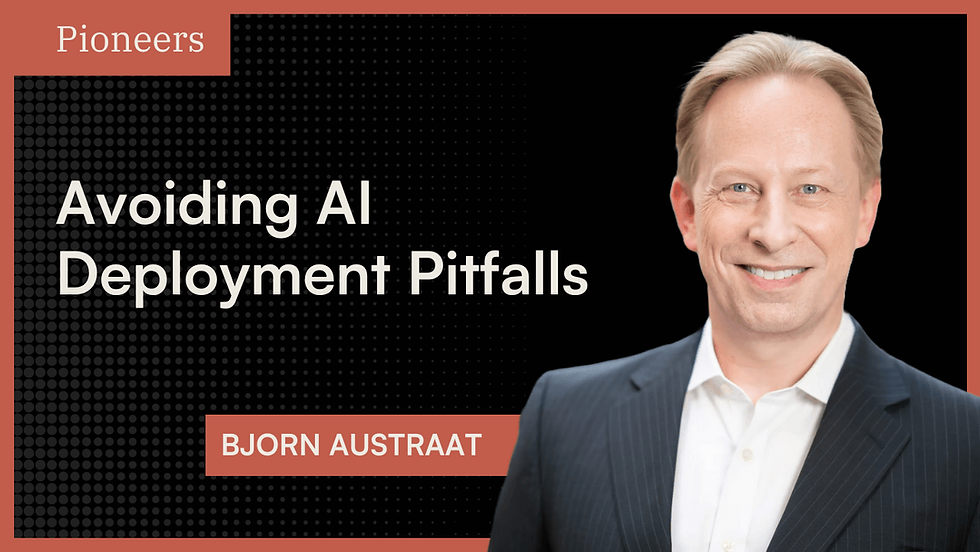
Scale Past the Prototype: Generative AI is so fluent that we often mistake its output for intelligence, making proofs-of-concept deceptively easy to build. Achieving real business value, however, requires tackling difficult hurdles like data privacy, model governance, and liability.
-
Focus on "Data Liquidity": Waiting for perfectly clean data is a "Fool's errand". Instead, ensure your existing data is discoverable and usable. You can also use safe, mathematically similar "synthetic data" to hyper-accelerate internal testing and vendor evaluations.
-
Unify Your Strategy: If highly motivated executives pursue independent "pet projects," it creates massive fragmentation and technical debt. A coordinated, leadership-backed platform strategy is essential to safely assess risks and avoid duplicated efforts.
-
Build for Agility: The AI market moves too fast for long-term development plans. Execute your deployments in agile 8-week increments, and design your architecture so you can easily swap out underlying foundation models without breaking the system.
-
Offer "Snackable" Upskilling: Multi-month training programs have low adoption rates; instead, offer upskilling in 15-to-35-minute increments. To retain top technical talent, remember that they are ultimately motivated by seeing their hard work successfully launched into production.
AI in Action - Real Enterprise AI (Podcast)
-
Treat AI as a Business Case, Not a Model: Most teams over-index on model performance. Force every initiative to define clear economic value, measurable outcomes, and ownership before any build begins.
-
Default to Simpler Solutions First: Many problems framed as AI are better solved with process fixes or RPA. Eliminate non-AI options early to avoid wasted cycles and unnecessary complexity.
-
Operationalize from Day One: Plan for deployment, not experimentation. Integration, change management, and downstream ownership determine success far more than model accuracy.
-
Build Governance Before Scale: Establish standards for fairness, explainability, and auditability upfront. Retrofitting governance after deployment creates friction and risk.
-
Use Synthetic Data to Accelerate Safely: Generate privacy-safe datasets to unblock experimentation, improve model training, and enable collaboration without regulatory exposure.
-
Create Reusable Internal Capabilities: Invest in shared assets like model libraries and code repositories. This reduces duplication and accelerates execution across teams.
-
Unify Strategy Across the Organization: Independent “pet projects” create fragmentation and technical debt. Align under a coordinated, leadership-backed roadmap.
-
Force Plain-English Value Communication: If a team cannot clearly explain impact in simple terms, the initiative is not ready. Executive understanding is a prerequisite for scale.
-
Adopt Portfolio Thinking: Manage AI as a pipeline of opportunities with explicit prioritization. Avoid isolated experiments that do not compound into enterprise value.
-
Build T-Shaped Teams: Combine deep expertise with broad business and communication skills. AI success requires translation, not just technical excellence.

Introduction to Claude Cowork (Tutorial)

Are you Claude Curious but don't know where to start?
I use Claude's Cowork mode every day to run my business. Client prep, contract review, presentations, research, financial analysis, content drafting.
But getting there took some configuration. Out of the box, Claude is smart. Configured properly, it becomes something closer to a working partner that knows your voice, your tools, and your preferences.
In this session, I walk through the four building blocks that make that possible - personalization, connectors, plugins, and skills - and I'll set them up live, on screen, so you can see exactly how it works.
A few slides to set the stage, then straight into live configuration and demos. You don't need to be technical. You don't need prior experience with Claude. If you've been curious about what (agentic) AI can actually do for your daily work - in practice, not theory - this is a good starting point.